
Full Spectrum Emotions
on going all in (even if you’re not an aries)

Days before I began teaching for the new quarter in January, I ran, full speed, into visual art. Sank into it out of a pure, paraverbal need to be cared for amid political devastations. Part treatment for current exhaustion and part preventative care to prep for the next wave of existential burnout courtesy of rampant and uncritical generative AI use in almost every crevice of my work life, I craved a container to hold these unnamed feelings. I desired an embodied experience unlike what I was getting from literary, filmic, sonic, or televisual narratives. Usually, when I’m in this emotional space, I make things – lumpy ceramic sculptures, collaged encaustic paintings, felted objects, or carved blocks for t-shirts or lino prints – to find my way out. To make sense again.
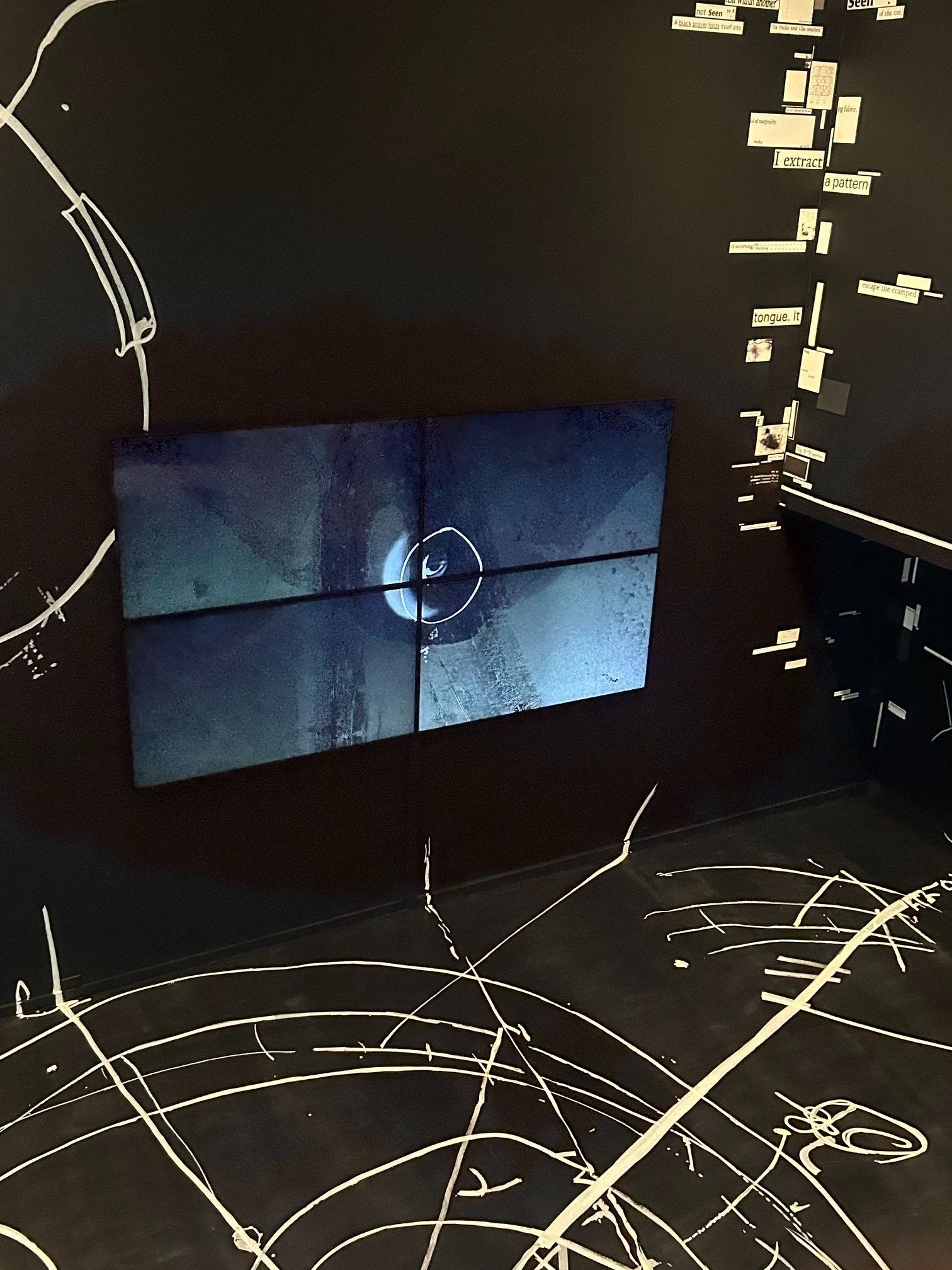
But making didn’t feel accessible; I couldn’t sit still. I couldn’t wrap my head around how to be ready, with full energy, focus, and heart, for a new crop of students. The quarter system is fast, with only 10 or 11 weeks to teach, and the pace of student needs can feel activating even before the machine-gun of headlines starts each day. So I went to the Henry Art Gallery, 15 minutes from me on the UW Seattle campus (free admission, folks!). I didn’t know what exhibits were on view since my last visit, but it didn’t matter. I found my way into Kameelah Janan Rasheed’s we leak, we exceed exhibit and it. was. a. balm.
I should probably clarify that video installation art doesn’t just make me swoon. I cried when I saw Mona Hatoum’s Corps Étranger not just once while studying abroad as an undergrad, but twice, again when I returned to the Centre Pompidou as a gift to myself upon the finalization of my divorce. My own body became foreign to me in the marriage, and wasted away as I tried to strategize when and how to escape it. Hatoum would re/learn her body; I would too.
When I first saw Ann Hamilton’s videos as a 13-year-old in the Guggenheim, I was transformed and simply wouldn’t do anything but sit cross-legged on the ground, telling my parents to come for me when they were ready to leave the museum. I was aroused by the opportunity to know a body in a new way; not to know someone’s body, but to know there are always new ways to learn the human body well beyond the personal or the medical or the sensual. I got to see Hamilton’s work again 10 years ago as part of her exhibit, the common SENSE, also at the Henry, and through animal feathers, guts, and skin, through the stain of newsprint on my fingertips and later on my cheeks, I reconnected with touch as the most liberatory sense.
Rasheed’s installation was as hypnotizing as it was grounding, the way stimulants can calm a brain and a body. I was lapped up by sensory experiences: sound on loop, video on loop with images layered, words layered and phrases fragmented, fragments of paper disintegrating in jars whose lids were screwed tight. Her two videos saturated me, reacquainted me with memories held by a body. Mere minutes after stepping into the black box cradling her art, crawling up walls and around poles and into corners of the ceiling, I could finally still. Then I could feel. Then I could name. Art had led me back to the verbal.
It’s exhilarating to find the right word for a thing. Naming as mirror stage. Lacanian psychoanalysis offers that when the infant finally recognizes herself in the mirror, the ego is formed. But it’s a faulty, impermanent, symbolic recognition. It’s good enough, as the Imaginary is. The right word for a thing is only the right word for a moment. We then chase for the new right word, foolishly believing we’ll eventually find the Real word for a thing. Language falls short when we try to capture a feeling.
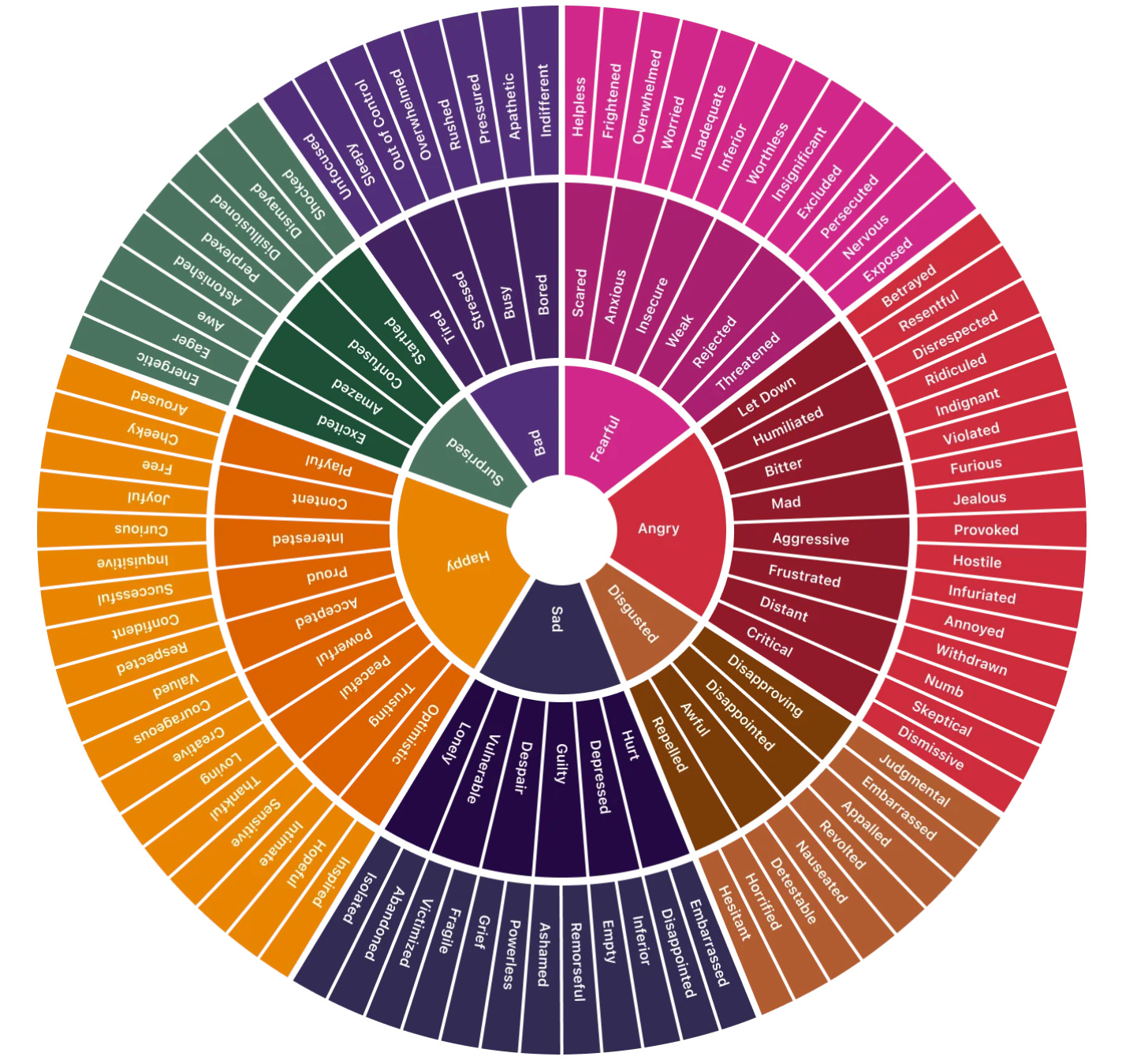
In my literature, creative writing, and rhetoric classes, I fall back on this feelings wheel. What do you want your essay to do to your reader? What is the writer doing to you in this chapter? How does the author feel about their subject? Which feelings are you breezily hopping over or avoiding in your story? And what’s at stake if you don’t look it in the eye, make eye contact, in the mirror?
And why was I insecure about offering a snapshot into my own moments of despair in the first paragraph of this essay?
And why was I nervous about offering a snapshot into my own moments of fragility in the first paragraph of this essay?
And why was I scared of offering a snapshot into my own moments of powerlessness in the first paragraph of this essay?
I tell students, and myself, to try out all the extreme feelings before they commit to the word. Jump in headfirst and then dial it back later.
By the third week of the quarter Renee Good, Geraldo Lunas Campos, and Alex Pretti were all dead. Murdered by ICE. How, then, to simultaneously mourn and show up with optimism to the 10-credit class Robyn and I were co-teaching: The Art of Activism.
On our first day of class we asked 3 dozen students to listen to Ginsberg’s “America” and rewrite it for our 2026 context. We first did this when we taught the class in 2023 and I cried hearing the students volunteer to read their words, struck by their disillusionment and disgust. Tears again as I heard these new students with even more outrage and ferocity than 3 years prior. (And in a couple of cases, the tears were for the painful naivete.) Rather than hide or defend the tears, I admitted this was just me, and proudly showed them my favorite sticker on my laptop case. But Robyn and I left that first day of class and almost all subsequent ones focused more than ever on the tone of the class: how to hold space for it, whether, how, and when to try to change it, when to try to name it and when to respond to it.
Luckily, we got to think about this in community with colleagues the very next week. On our campus, most instructional, curricular, and pedagogical professional development is organized by the Teaching and Learning Academy Steering Committee, and led by an appointed Faculty-in-Residence. Each year there’s a half-day Faculty Institute filled with presentations by us, for us. After visiting Rasheed’s Henry Gallery exhibit, I knew I’d pitch a session, which evolved into:
Cryfest/Joyfest: Full Spectrum Emotions As Democracy Crumbles
A week into January and it’s hard not to cry all the time. Students feel it. We feel it. But we also see beauty: in the ferocity, in the tenderness, and in the delight of the unexpected humanity around us. So let’s talk about how to make space for the full spectrum of emotions in response to the state of our democracy. This is primarily a show-and-tell session meant to spark discussion. We’ll start with stories of class adaptations, then share some tried-and-true ways to invite joy into the class while making space for the horror. We’ll even have one or two tricks up the sleeve that will have you leaving with a chuckle!
I wanted the session to offer something to faculty who felt they had no time and to those with a bit more flexibility, and to faculty who could easily imagine how politics, humanity, democracy, and affect fit into their curriculum as well as those who couldn’t but would be open to discipline-agnostic instructional approaches. My tender friend and colleague who teaches about happiness, Natalie, and I co-facilitated the session and populated a quadrant diagram with ideas.
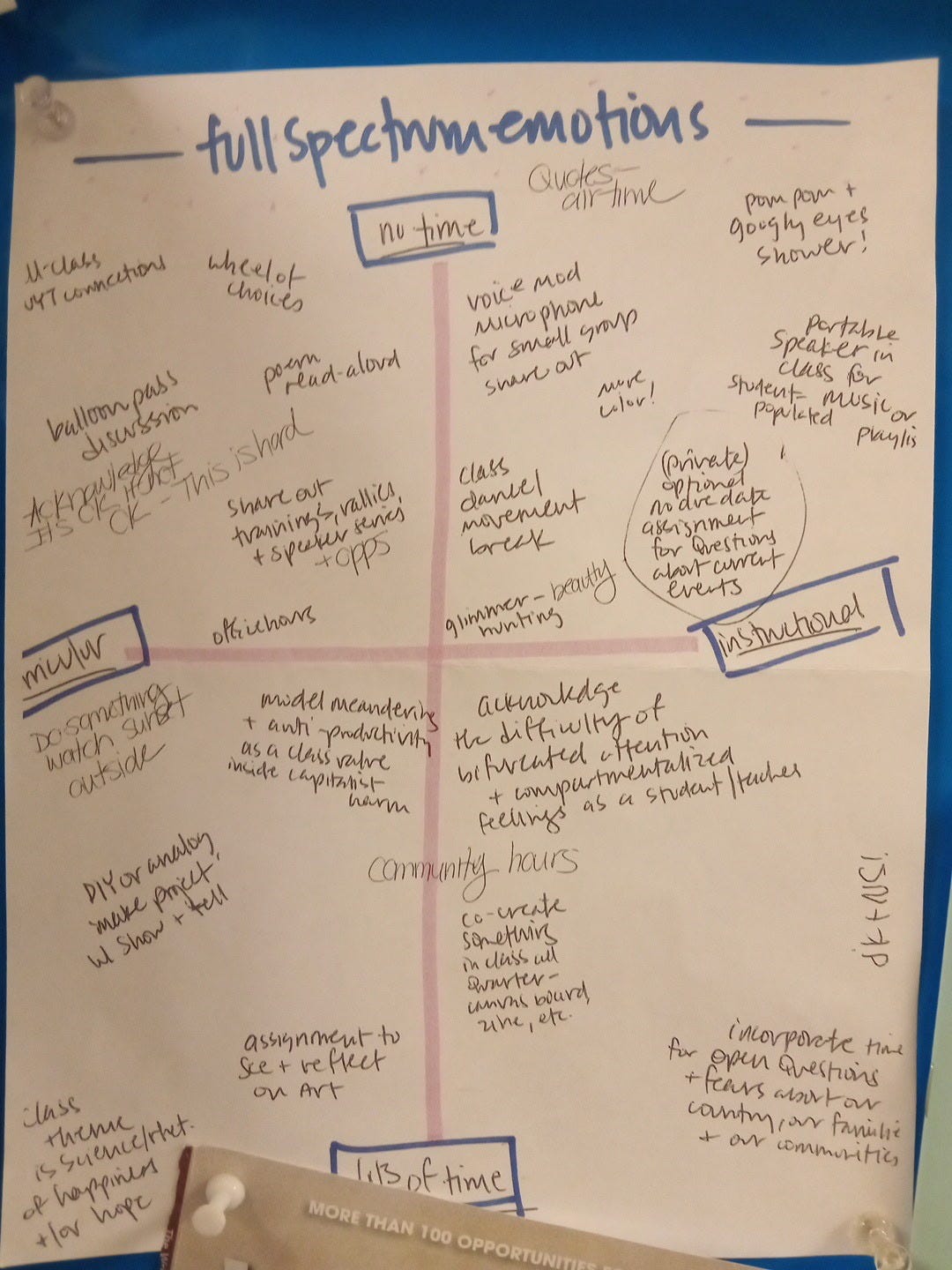
Performing some of the strategies on the sheet, I passed out colorful pom-poms and googly eyes, which I have a healthy supply of at all times because of my husband’s penchant for tactile whimsy, and got some chuckles from faculty, including reluctant ones who didn’t want to “come cry” during the work day. Fair. As folks arrived at the session, I played three versions of a song I think we can all agree sets the vibe we’re all after, amiright? [N.B. There’s definitely a forthcoming essay about the politics of music selection in the classroom.]
Our conversations moved to the wide-ranging but consistent gravity of faculty positionality, of activist identities out of the classroom, of fear for student and self, of a deep need for some faculty to have more protection before even mentioning current events, of an equally deep need to have a single space that isn’t focused on current events, and of yet another equally deep need to teach nothing but how to repair the Republic.
The session was a personified feelings wheel, and a few people left admitting that they might not change anything in their classrooms but that we needed to keep holding space for these conversations, and regularly.
So the quarter continued as an experiment of going all in, of throwing all the strategies into the soup and seeing what floated and what sank. I learned that a spontaneous dance party might have worked once, but the extra energy to rally people who don’t feel like it actually makes me leave feeling more bummed. I learned to thicken skin when half the class vibes with the music played during break and actually chats with each other while the other half puts on headphones. I learned that most students really liked the dopamine hit of a randomly tossed googly eye. And I learned that the action that got me the most private follow-up student emails was simply holding space and asking, without multitasking, in an old-school circle, how is everyone doing.
Over the last three years, I’ve read numerous articles about social prescribing: an idea that connects people to community events like concerts, writing workshops, art classes, or even free memberships to museums and parks. The concept seems to have originated in the UK and keeps popping up in community clinics and college campuses across the US. One crucial part of the idea is the social element, and the other is the life-saving act of creation: of crafting or making. Without knowing it, I was turning my class into its own social prescribing program – designing assignments that sent students to the Henry Art Gallery, to open mic events on campus, to free concerts nearby, and to our almost 60-acre campus wetlands – but without the institutional infrastructure that would point to efficacy, namely, individuation based on a single student’s needs and constraints.
This Spring, I still sent students to see Rasheed’s exhibit, and their essays reflected all the feelings. But I’m also thinking about where Robyn and I landed in our Art of Activism class: that the best way to end the quarter was not another discussion about rushed impressions of how we process current events, or even another whole class dance-in, but with communal crafting, in the form of an art book and zine making workshop, as a skillset that offers a path to a more hopeful future.
And I, too, found my way back into making in the form of carving a linoleum block for The Kerning Lab’s first annual tote bag, just a little bit late, in celebration of our one-year anniversary here. We’re also cooking up a virtual book club to kick off in early summer, and I’m expanding the weekly coworking writing session I’ve run for two years this summer, too. Making words, making art, making community. Readers of all kinds, I’m naming this current feeling as appreciative of you.
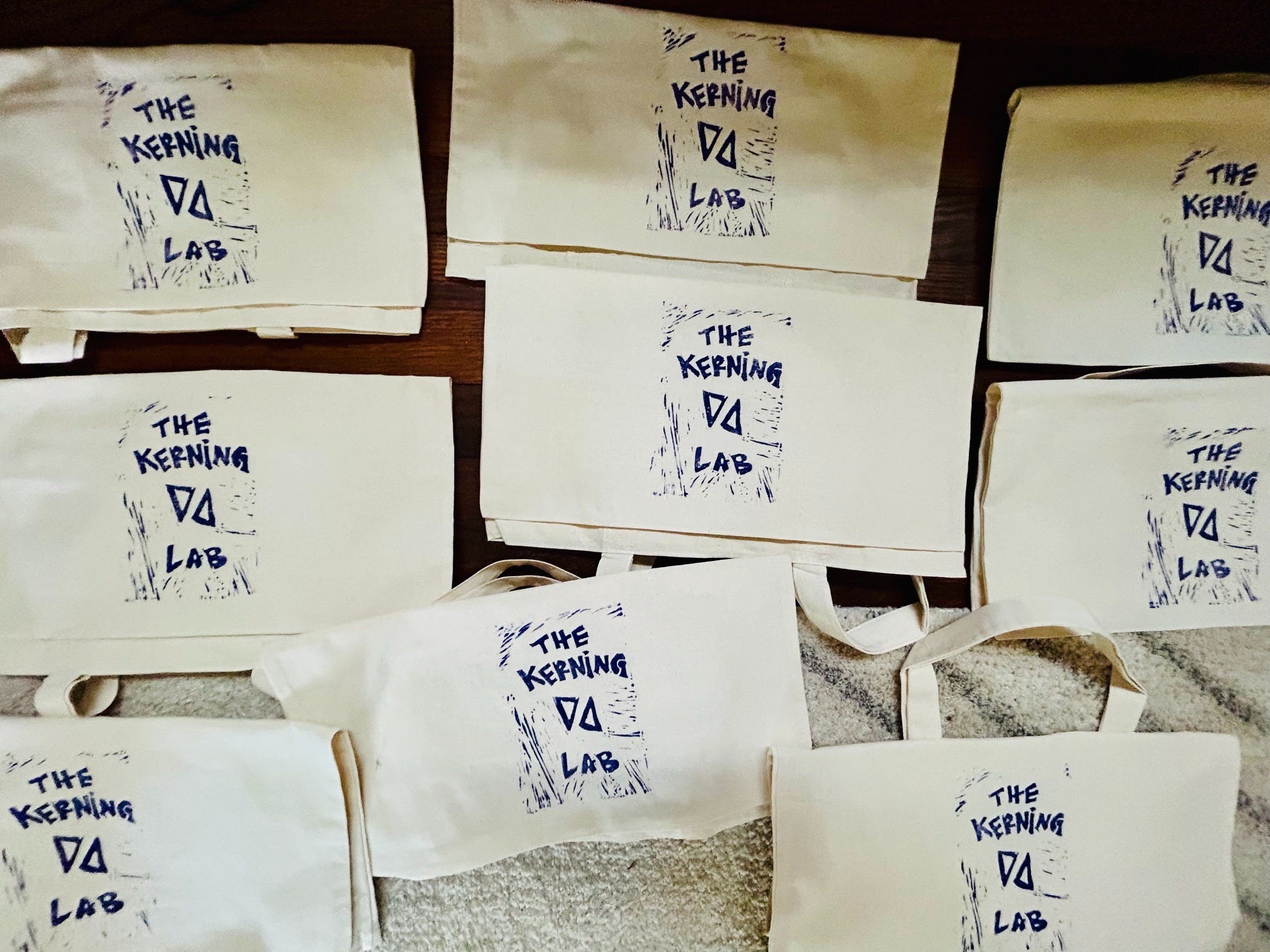
(Paid subscribers, yours is in the mail, waiting in your mailbox, or on your shoulder already! Upgrade to join in the fun!)
that's what I'm talking about
And the universe was listening, because yesterday, the day this came out, the word of the day was weltschmerz!